Chocolat
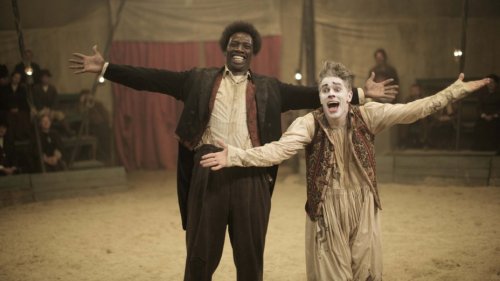 “Your success is an insult to white people. Negroes must know their place.” — It’s a blunt statement from the film Chocolat, but a brutally honest account of the entrenched racism of nineteenth century France which acts as a warning to the viewer that Chocolat isn’t just about the whimsically joyful world of clowns from yesteryear.
Chocolat tells the true story of Rafael Padilla (played by Omar Sy from The Intouchables), a former slave who is employed by a small-time circus in provincial France. The year is 1897 and his role as the wild eyed “cannibal” baring his teeth scares, delights, and indulges the audience’s prejudices of the time. But when he is discovered by George Footit (actor James Thierrée – grandson of Charlie Chaplin), a struggling clown in desperate need of upping his game, the comedy duo Chocolat and Footit is born. Soon after, the prestigious Parisian Nouveau Cirque gets wind of their act and sends them slap-sticking their way to fame and fortune.
As the saying goes, ignorance is bliss and Rafael appears unconcerned about the broader racial implications of a black man being physically abused for laughs. The crowd is adoring and he is paid handsomely, even if his white partner, Footit, is paid more. However, during a short stint in jail he meets Victor, a black activist, who enlightens Rafael to the fact that he is only playing someone else’s whipping boy, rather than the artist he sees himself to be.
Meanwhile, the consummate professional, Footit appears to be more colour-blind than those around him, perhaps due to recognising similar struggles of bigotry. The film alludes to his homosexuality but is never explicit about it, suggesting that this film is as much about sexual identity as it is about race.
Nonetheless, the film wears its racial concerns boldly on its sleeve and forces us, the movie going audience, to observe another audience laugh and holler at the racist antics within the circus ring. However, it’s not long before you realise that you’re stifling a few laughs of your own at Chocolat and Footit’s down-right hilarious hijinks. The irony is palpable and you start to question whether you are complicit in your laughter, or whether it is testament to two very funny men whose performance transcends racial boundaries.
Roschdy Zem does an adequate job at directing this solid biopic, but its lavish production values just can’t match the two wonderfully charismatic and convincing performances of Sy and Thierrée. A film worth seeing for their performances alone.
You can see my published reviews here.
 With the darkness of winter imminent and New Zealand gardens well into lock-down, it seems an odd time to release an optimistically colourful film about an English garden. Perhaps it was a scheduling decision by the studio to make Lions supporters feel more at home. However, all is not well in an English garden.
 It looks like Universal Pictures want some of that lucrative franchise action. In the opening credits to The Mummy we are introduced to the “Dark Universe” logo — a series that is being spearheaded by The Mummy in what appears to be a new world of characters born out of classic horror; The Hunchback, Dr. Jekyll, Frankenstein, and Dracula, to name a few. Although, if The Mummy is any indication, they’re going to make a monstrous mess of the whole lot.
 “Am I still a twin if my twin is dead?” — a question posed by the protagonist of Rachel Tunnard’s debut feature, Adult Life Skills. The question succinctly sums up the film’s central thesis into what makes us whole; specifically when someone we love so dearly feels like they are a part of our being. Thankfully, such heavy questions are complimented with large dollops of humour, thanks to Tunnard’s witty script which is infused with as much playfulness as it is with existential insight.
 tobywoollaston.com