A Hidden Life
Verdict: A deeply moving Malick mood piece.
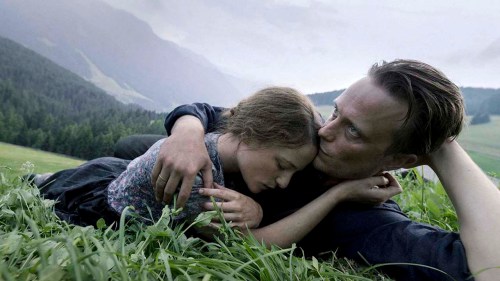
Based on the letters between Franz Jägerstätter, an Austrian conscientious objector during the Second World War, and his wife Fani (played by Valerie Pachner), this true story revisits one of history’s many forgotten wartime martyrs. The couple forge out seemingly utopian lives as farmers outside a remote village beneath the picturesque Austrian Alps. But when Franz (played by August Diehl), a devout Christian, refuses to bend the knee before the evil of Hitler’s Nazi regime, it threatens to shatter their idyllic lifestyle. His refusal to sign an oath of allegiance is an act that would have him thrown into prison and potentially sentenced to death for treason.
Those who appreciated writer/director Terence Malick’s masterpiece The Tree of Life, will welcome Malick’s return to form. He’s had a few misses since, but A Hidden Life represents a renewed conviction for his craft—one of whispered fever dreams laced with periods of lucid connection to nature, all built on liberated camera movement, vibrant imagery, and oiled with fluid editing patterns. It is tactile film-making par excellence that pipes straight into your soul. Yes, Malick’s best films are more spiritual experiences rather than mere entertainment.
However, at nearly three hours long some might find Malick’s contemplative style too taxing, with a seemingly endless supply of swooning camera movements that are sublime, yes, but also numerous. Those less versed in Malick’s style will question if this relatively simple story could’ve been trimmed to a more digestible length. For that, Malick himself might be considered a conscientious objector to today’s popcorn movies, stubbornly forging out a work of meaningful cinematic art without bowing the knee to today’s ever shortening attention span. I applaud him for it, because what we have here is a master work.
A Hidden Life unflinchingly locks us inside Franz’s moral conundrum. First showing paradise, with humanity and nature living as intended high in the pristine Austrian Alps, and then with a slow, prowling, cloying, camera ushering in the inexorable threat of Hitler. Paradise lost, indeed.
It’s an anachronistic parable for our Trumpian times, sympathetic to lives of moral fortitude lost in the white noise of history. A Hidden Life is a graceful and hauntingly beautiful symphony for the senses that is urgently pertinent. I loved it.
See my reviews for the NZ Herald here and for Witchdoctor here.

 tobywoollaston.com