On Chesil Beach
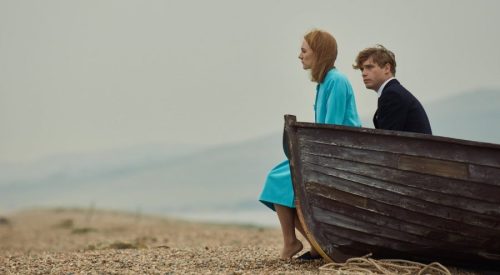 Wedding night nuptials have never felt this awkward. Ian McEwan’s (Atonement) adaptation of his own Booker-nominated novella, On Chesil Beach, opens with a sweet young couple walking hand-in-hand along the titular beach. Their honeymoon suite awaits. What could possibly go wrong? Well, for starters it is immediately apparent that these two brits—a blushing English bride and a handsome but bumbling groom—have a physical intimacy as fragile as glass.
Set in 1962, ironically at the dawn of the sexual revolution, On Chesil Beach pits good will against the brutal truth of sexual countenance. Slowly, through flashbacks, we learn about Florence (Saoirse Ronan) and Edward’s (Billy Howle) romance that leads to their engagement which was born on the wings of a burgeoning friendship more than sexual attraction. Now, in their honeymoon suite, there is something clearly amiss as the couple struggle to consummate their marriage. Bereft of any physical warmth, their honeymoon quickly becomes stilted, self-conscious (almost comically so) and strained. The sexual subtext occupies the room like a rutting bull-elephant. And despite the clipped “no sex please, we’re English” demeanour the film addresses the topic head-on with the momentum of a freight train. When inevitable derailment eventuates, you wonder how it happened so quickly.
There are, of course, reasons behind their awkward courtship, one particularly pointed event, which McEwan has chosen to only hint at. For the most part, the film concentrates on the immediate break-down of their relationship. The confidence of a novelist who has adapted his own book is in full effect here and feature director debutant Dominic Cooke has done a commendable job managing McEwan’s material, helped immensely by Ronan and Howle’s vivid performances.
Unfortunately, the film’s final throw, a desperately sad flash-forward, loses itself in inches of poor facial prosthetics. A shame to have the story tarnished by a technical distraction, because otherwise On Chesil Beach delivers solid performances, an intriguing story, and perhaps the most beautifully framed final shot I’ve seen in a while.
See my reviews for the NZ Herald here and for Witchdoctor here.
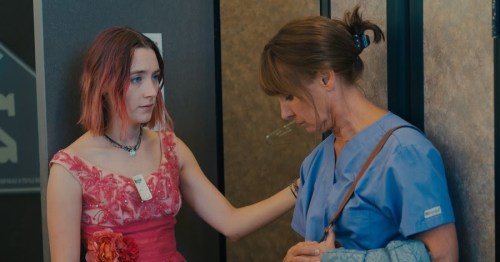 Greta Gerwig is no stranger to mixing a celluloid cocktail of angsty humour with a twist of social realism. In her sophomore years, the fledgling writer/director/actor was understudy to Noah Baumbach, both bringing about delightful films such as Francis Ha and Mistress America. With Lady Bird, Gerwig has spread her wings, gone solo, and showed us what a genuine talent she is.
 The process of animating over the top of pre-shot footage (rotoscoping) is a procedure that has existed since the dawn of cinema, most notably applied recently by Richard Linklater (A Scanner Darkly and Waking Life). Loving Vincent pushes the envelope further, with Directors Hugh Welchman and Dorota Kobiela (and an army of artists) making the technically ambitious decision to turn their film into a Van Gogh oil painting through the arduous process of hand painting each frame. While some might find this a painstaking exercise in gimmickry, there is little doubt that the result is an immersive experience, nudging you ever closer to the work of the famous Dutch painter. Certainly, Loving Vincent is a film where you could hang any one of its overwhelming 65,000 frames on your wall—although at twelve frames per second, the resulting animation takes a little adjustment.
 tobywoollaston.com