
Film Stars Don’t Die in Liverpool DVD review
 Based on Peter Turner’s memoirs, screenwriter Matt Greenhalgh has teamed up with director Paul McGuigan (Victor Frankenstein) to recount the unlikely, but true story of a romantic relationship between a Liverpudlian youngster and a Hollywood starlet twice his age.
Matt Greenhalgh is no stranger to adapting true stories from entertainment’s yesteryear. His profiling of Joy Division’s Ian Curtis, Control (2007), was a stunning rendition of the band’s enigmatic lead vocalist. However, Film Stars Don’t Die in Liverpool is quite a different beast.
It is 1979 and Gloria Grahame (Annette Bening) is working a season on the stage in Liverpool when by chance she strikes up an amorous relationship with Peter. In the twilight of her career, the rather flighty Gloria (every inch as you’d imagine an ageing Marilyn Munro) maintains a superficial femme fatale demeanour which matches the films she was famous for. She is a product of Hollywood; flighty, conscious of her image, and very sensitive about her age. Ironically, it is the many years between her and Peter that raise conjecture among the people around them. Peter (played by Jamie Bell) is a stage actor who naively falls for Gloria’s wily charm. He is “the boy who just can’t say no” as she knowingly quips, and his doe-eyed innocence is luckily met by a woman who genuinely falls in love with him.
The film elides time beautifully as it employs a flashback structure to tell the backstory to their relationship. And although based on Peter’s memoirs it is appropriately sensitive to Gloria’s side of the story. The result is a simple but reasonably compelling love story bolstered by the protagonists unlikely coupling and the intriguing factual examination of an Oscar-winning Hollywood star’s final years … you may have guessed from the title, but she doesn’t die in Liverpool.
Topically some might find Film Stars a tad depressing. The dour Coro Street-like colour palette certainly doesn’t help matters—it is the kind of visually drab film that leans heavily on its cast. Thankfully, Bening and Bell do a fine job providing believable and touching performances that drip with genuine pathos and chemistry. Julie Walters also turns in a solid, if slightly predictable performance as Peter’s mother.
The DVD offers a special featurette on the method of back projection used to create the Californian portion of the film. It is only a few minutes long but gives a welcome peek behind the curtain—the film’s slightly surreal quality eliciting a visual mix of fact and fantasy that links with Gloria’s film-noir background. Other than the featurette, the DVD gives you the film rendered in 1080p with sound in Dolby Digital 5.1. The sound, while not pushing any groundbreaking boundaries is accurately mixed and appropriate to the film’s tone.
See my reviews for Witchdoctor here.
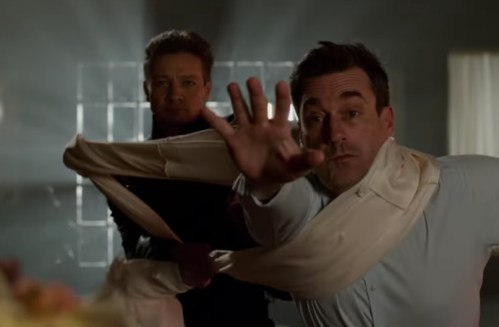 It’s hard to believe that among the homes and workplaces of ten “ordinary” men, there is a very serious and highly spirited game of tag happening. Director Jeff Tomsic has teamed up with screenwriter Mark Steilen to tell their story.
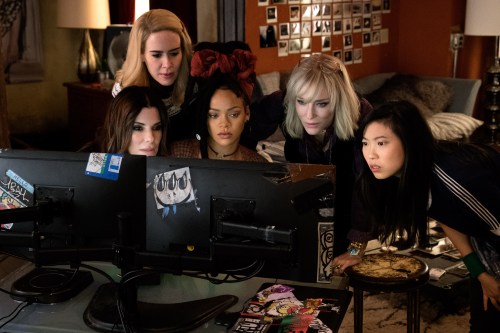 It’s been over a decade since the Ocean’s trilogy planted the then “it” men George Clooney and Brad Pitt firmly within the heist genre. Now director Steven Soderbergh has handed the reigns over to Gary Ross and instead of Clooney and Pitt, we have the “it” chicks Bullock and Blanchett to head up an all-female crew of eight; including Helena Bonham Carter, Mindy Kaling, Rihanna, Awkwafina, Sarah Paulson, and the delightful Anne Hathaway.
 After a well-received run at last year’s NZIFF, 20th Century Women finally gets some more big screen love. Brimming with warmth and wit, this enlightening if slightly meandering tale provides plenty of post-viewing conjecture to unpack.
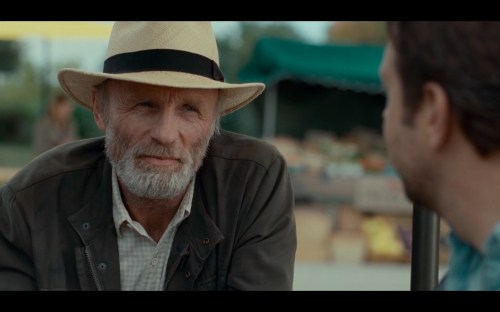 Digital giant Netflix’s bankrolling of a film that champions all things analogue is an anachronism that some might smirk at. Others will nostalgically nod at Netflix whose roots lay in the twilight of physical media.
 On my way to work, I saw a young student walking along the footpath, open book in one hand, a half-eaten apple in the other, lost in what must’ve been a good read.
 It seems ironic that such an agile and articulate documentary can be born from the burnt out husk of a drug-addled rock band. But that is exactly what first-time documentarian Julian Boshier has produced. The aptly titled Swagger of Thieves chronicles the fortunes of the “almost” iconic kiwi hard rock band, Head Like a Hole (HLAH). Their misspent potential is a schtick that is perhaps a well-trodden path of many bands, yet Boshier has managed to show an exceptionally candid side to HLAH’s story.
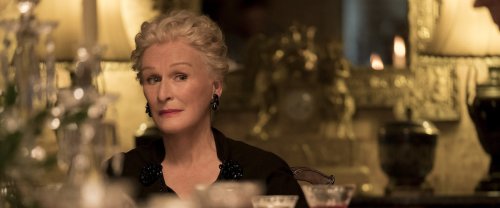 That this murder mystery is pleasingly old-school only serves to bed in well with its source material. Agatha Christie’s sordid tales of murder and mayhem have long been a rich source of cinematic intrigue since the age of silent cinema, often with mixed results. But here, director Gilles Paquet-Brenner has done an admirable job with a conservative but well-considered adaptation of arguably Christie’s most twisted tale.
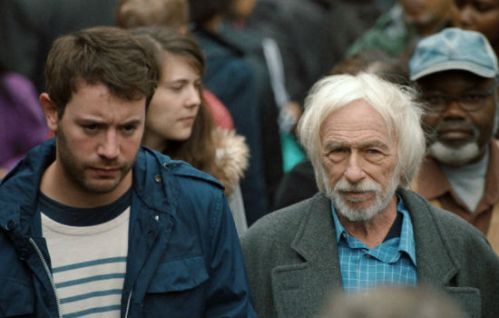 French writer/director Stéphane Robelin (All Together) appears to have developed a penchant for warm-palleted comedies; the kind of light-hearted crowd pleasers that go down well with dinner out and a glass of red.
 A very Marlon Brando-esque Jason Clarke (Zero Dark Thirty) takes the lead as the last surviving son of Joseph Kennedy’s flagging dynasty in this tale of political intrigue and moral soul-searching.
  tobywoollaston.com