Atomic Blonde
 The name is Blonde, Atomic Blonde. Actually, her name is Lorraine which doesn’t have quite the same zing … but other than that, Charlize Theron’s new role may as well be a female Bond (or perhaps more accurately a female Bourne).
It is 1989 and the Berlin Wall is about to collapse, signifying the end of communism in Europe’s East. However, a rogue list naming covert operatives is in the wild and it threatens to halt the pro-democracy movement. Enter Lorraine Broughton (Theron), a spy for Britain’s MI6 who is sent to retrieve “the list”. Her point of contact in Berlin is David Percival (James McAvoy) and together the two navigate the cagey and violent world of espionage.
Set against a backdrop of graffiti, punks, physical media, and eighties music (including the obligatory Falco and Nena), Atomic Blonde makes damn sure you know it’s the eighties. Cinematographer Jonathan Sela frames the film with a graphic novel sensibility (from which the story originates) and every opportunity is taken to bathe scenes in neon pinks and baby blues.
In his first feature film as Director, David Leitch has employed his background as a stuntman to great effect. Technically there is little to fault the film’s kinetic flair with impressive set pieces and fight sequences that evoke a genuine physicality.
Although we’ve seen this kind of spy story many times over, the film competently negotiates the pitfalls common to the genre; in particular the delicate balance between over or under explaining its many plot complications. Atomic Blonde’s flashback narrative structure goes some way to alleviate such problems.
Most notably, Atomic Blonde is a comment on the current gender imbalance in spy thriller films (similar to Wonder Woman’s take on the superhero genre). Casting a woman as your protagonist is one thing, but when she excels in what is traditionally a man’s domain, then it becomes a statement. At one point a character who is sympathetic to the old communist regime utters “Women are always getting in the way of progress”—to which Theron’s sharp retort is clearly a rebuke of such antiquated notions.
However, dig a little deeper beyond the style and gender concerns and (like Wonder Woman) we are met with a bog standard genre flick that, while competently handled by its Director, walks a well-trodden path. For some, this will be enough, but others might consider Atomic Blonde to be a little hollow.
You can see my published reviews here.
 Good rom-coms have been a rare commodity of late, so The Big Sick’s critical success at Sundance has been somewhat of a shot in the arm that the genre sorely needed.
 The Dinner combines sophisticated cuisine with a stale burger patty in this adaptation which feels at odds with Herman Koch’s bestseller of the same name.
 Christopher Nolan’s Dunkirk remains a giant at the international box office despite entering its fourth week of release. What better time than now to offer a belated review and perhaps offer a pearl of insight not observed by the mountain of glowing praise by other critics. Well, I’m afraid to report that I have little to add to what has already been said about Dunkirk. So … sorry if this sounds a bit like a broken record.
 Like all Edgar Wright movies, Baby Driver is a kinetically charged explosion of style. A lively thrill from start to end laced with musical sensibilities. But considering his previous work (Shaun of the Dead and Scott Pilgrim vs. the World, to name a couple) this should come as no surprise. He is a restless director who seemingly enjoys turning simple plot-lines into hyper-jazzed feature length films … and he does it so well.
 He is a man blessed with a wild imagination and great hair (his cranial embellishments second only to his kissing-cousin Jim Jarmusch). An iconic film-maker that has given us enigmatic worlds of fractured logic and narrative ambiguity hearkening back to the surrealists of the early twentieth century (Luis Buñuel, Germaine Dulac, Salvador Dali, et al.). Mulholland Drive, Wild at Heart and Blue Velvet are just a few of his filmic canon that any cinephile should wax lyrical about … but less is known about David Lynch’s formative years as an artist.
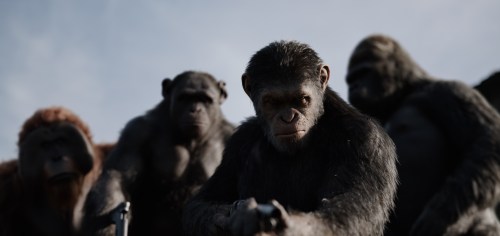 Contents don’t always match what is printed on the tin. War for the Planet of the Apes’ lengthy title (let’s just call it WPA) and marketing material suggest that you’re likely to be be subjected to two and a half hours of bloodshed, courtesy of a certain Wellington digital effects company. But WPA is far more introspective than advertised. Sure, it’s not La La Land, but WPA has a lot less “war” in it than we’re led to believe. Critically, comparisons have been made with Ford Coppola’s Apocalypse Now. Famously, Ford Coppola reworked Joseph Conrad’s novella Heart of Darkness, by expressing its themes of colonialism, self-discovery and the meaninglessness of evil against the backdrop of the Vietnam war. In WPA the astute viewer will pick up on this comparison fairly quickly, but for those not familiar with Coppola’s film, a wall graffiti’d with “Ape-pocalypse Now” is plain for all to see.
 Long Way North has finally made its long way south onto our screens. Having screened as part of last years NZIFF, its theatrical release brings about the welcome return of its low-fi animated appeal. The film is a co-production out of France and Denmark and is Rémi Chayé’s debut feature in the directors chair (or wherever directors plant their bum for an animated feature these days).
 “Your success is an insult to white people. Negroes must know their place.” — It’s a blunt statement from the film Chocolat, but a brutally honest account of the entrenched racism of nineteenth century France which acts as a warning to the viewer that Chocolat isn’t just about the whimsically joyful world of clowns from yesteryear.
 With the darkness of winter imminent and New Zealand gardens well into lock-down, it seems an odd time to release an optimistically colourful film about an English garden. Perhaps it was a scheduling decision by the studio to make Lions supporters feel more at home. However, all is not well in an English garden.
