An analysis of Gilda
Not mad on classical film noir, although I quite enjoyed Gilda ... its style alone was quite captivating. I wrote an essay on Charlse Vidor’s classic last year. You can see the abstract here.

Not mad on classical film noir, although I quite enjoyed Gilda ... its style alone was quite captivating. I wrote an essay on Charlse Vidor’s classic last year. You can see the abstract here.
It been a couple of weeks since my last update. It is the beginning of term and so my focus has shifted towards my thesis and the cinema of Aronofsky. Things might be a little sporadic this year. To that end, I have recently revisited Aronofsky’s Pi, Requiem for a Dream, and The Fountain. I had forgotten just how good The Fountain is. Perhaps the end is a little overworked, but other than that, it is a masterpiece. I’m starting to snuggle my thoughts into the idea that Aronofsky’s films are examples of “cinema of absent presence”. A concept that I was introduced to in Dillon’s book The Solaris Effect. He examines how Tarkovsky, in his film Solaris, explored the relationship the viewer has with the screen fiction being observed; experiencing a reality, but in fact only observing celluloid. Woody Allen more directly explored similar ideas in The Purple Rose of Cairo and I believe Aronofsky is, perhaps unintentionally, stepping on similar grounds. Four of his five films appear to explore the haves and have-nots of cinema, and this is the direction I seem to be currently heading.
Of other films I have recently seen …
Jeff Nichol’s Take Shelter; I have heard a lot about Jeff Nichols but this is the first film of his that I’ve seen. Michael Shannon does an impressive job playing Curtis, a blue-collar worker who starts to suffer panic attacks resulting in visions and paranoia. The ensuing strained relationship with his wife is equally impressively played by Jessica Chastain. Perhaps a little overdrawn, this film is for the most part a superb and unique portrayal of a very real mental illness. Rating here.
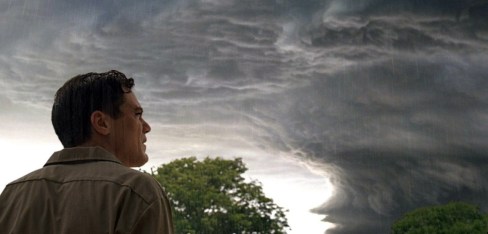
Take Shelter
The Perks of Being a Wallflower; “I feel … infinite”, a sentiment expressed by Charlie (played by Logan Lerman), which so aptly describes that feeling of youth. A kind of invincibility that we all felt when we were in that limbo period between child and adult. My brother described Perks as being a current day The Breakfast Club (despite being set in roughly the same era), which tonally describes this film well. There is, however, a lot more going on in this film. Directed and written (both book and screenplay) by Stephen Chbosky, The Perks of Being a Wallflower, centers around Charlie. An awkward freshman desperate to fit in, he falls in with a group of empowering but quirky seniors. The film beautifully develops its characters and unfolds Charlie’s darker mysteries with good consideration. I found Perks to be well balanced, really well acted, and for me will probably be the surprise of the year … but to be fair I wasn’t expecting much. Rating here.
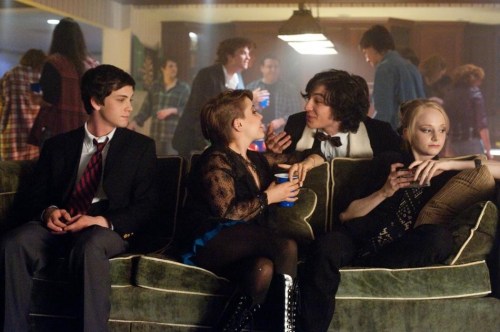
The Perks of Being a Wallflower
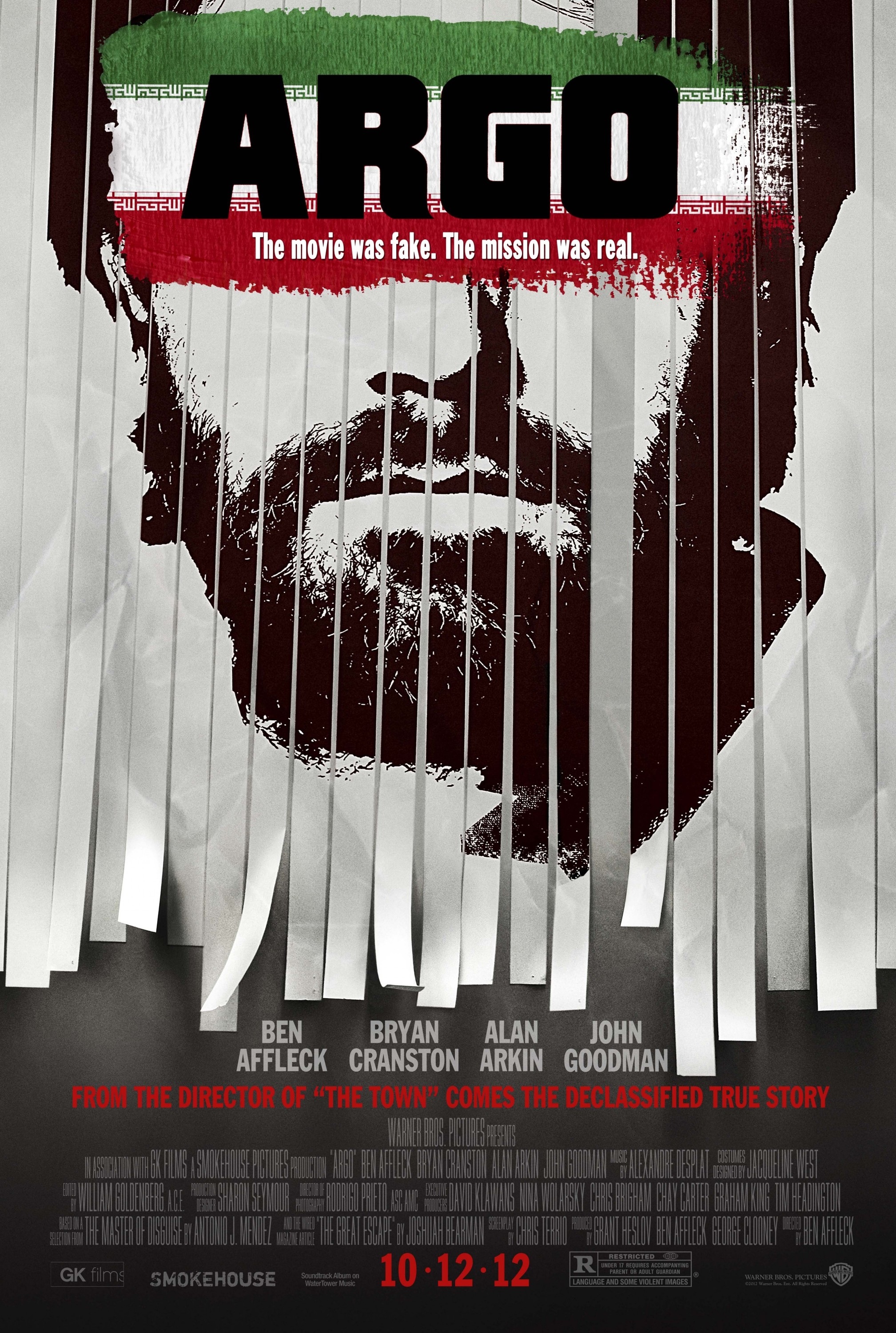
Argo; an interesting, tense, and humourous film that is let down a little by its saccharin ending. Built on a tension/release structure Argo superbly ratchets up tension, but unfortunately the release was an overly engineered emotive response. I’m sorry for my sweeping generalisation, but why do so many American movies needlessly go in for the “high five” ending. No such thing in Tinker Tailor Soldier Spy. Different film, I know, but you get the impression that had it been made by the Argo crew … well, you know where I’m going with this.
I’m nitpicking, on the whole Argo is another solid piece of film making by Affleck, well acted, a tight script, and looked beautiful. It had me googling events afterwards. Not sure it should’ve won the best picture Oscar though, but I’m beating my head against a wall there.
Trailer and my rating here.
One thing about watching a Tarantino film is that you know what you’re in for. Sometimes he surprises, but more often than not it is an over-the-top ultra stylistic violent romp through a scape dripping with cool tunes. This is no different. It’s an incredibly attractive film with charismatic performances from Waltz (I can’t fault this Oscar nod), Jackson, DiCaprio, and Foxx. Above all this is a commentary on the struggle for freedom. Specifically the black struggle for freedom, but can be applied to any of the oppressed in our world. Despite its obvious inaccuracies, the narrative can only be interpreted as empowering for blacks … I cannot understand any argument to the contrary.
Technically a little disjointed and aimless in parts, I still found Django Unchained entertaining, disturbing, and enlightening. Although I still have to question if the gratuitous violence is necessary; it has become such a trademark of Tarantino that its inclusion seems necessitated by audience expectations and thus risks obscuring of the film’s message.
See the trailer and my rating here.
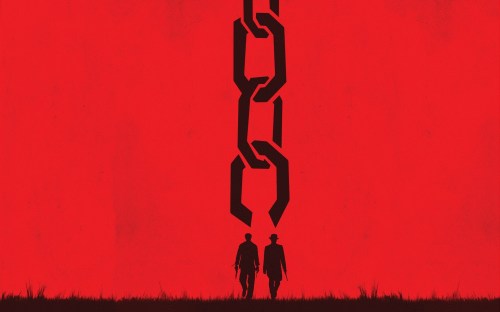
Django Unchained
Ok, a little rant here on the use of violence in films. I’m talking specifically about violence that does not aid character development, narrative, aesthetic, or an intentional ironic subtext, … no, this is violence simply to pander to the audience and tick a production check box. Such eye candy only serves to satisfy the voyeuristic curiosity of a dumbed down and lazy audience who guffaw at the new and novel ways a person can be mamed. An audience that has to be spoon fed the visual and aubible experience, rather than cogitating the possibilities. Yes, there are violent onscreen characters, and they have to be depicted as such, but the current mainstream habbit demonstrates how today’s audience demand immediate gratification and over explanation. It’s a shame.
I’m not saying that there should not be onscreen violence. It is not the violent acts themselves but the depiction of these acts that I question. It is about context. For example, the violence of the Normandy landings in Saving Private Ryan, are used to shock and bring about the reality of a situation. Violence in James Bond, however, is used in an entirely different way and I would like to contrast Skyfall with its two predecessors, Quantum of Solace and Casino Royale. Granted, these are essentially action flicks, but recent Bond films have demonstrated a desire for corridors filled with baddies lining up to be shot, have their limbs snapped, or necks broken. Skyfall (my hat off to Sam Mendis) demonstrated perfectly how a Bond film can be made to better effect, essentially with the same amount of violence, but handled in a more considered fashion. I site the Skyfall‘s silhouetted fight scene atop an empty sky scraper (pictured below, shot by Skyfall‘s DOP Roger Deakins) as a perfect example of a Bond fight scene handled to maximum effect. A scene that otherwise would have been a dull coreographed bone snapping 30 seconds of nonsensical time wasting washing over the screen.
More often than not a good film teases it audience with “less is more”. Imagination is a far more powerful instrument and can fill in the blanks to greater effect. I am not offended by on screen violence per se … but I am offended by its waste of valuable screen time, and its attempt to speak to me on such simple levels. Violence in films is an exceedingly large topic, one that I’ve only touched on … just thought I’d throw a few thoughts out there.
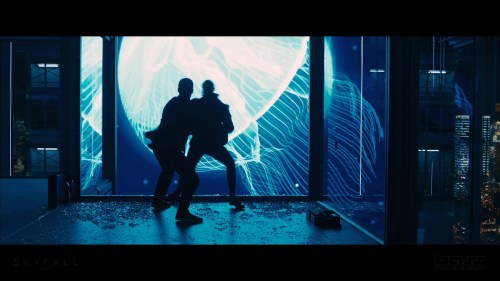
Skyfall
Silver Linings Playbook is an entertaining and lighthearted drama that has little more to remark it. A lot has been made of Jennifer Lawrence’s performance. Contrast can shed some interesting light on a performance. Lawrence, who has demonstrated her acting chops in Winter’s Bone and The Hunger Games, perhaps comes across a little flat here … but maybe it is because I am comparing this with her previous roles. Bradly Cooper, however, benefits from the opposite and surprised me with a role that is interesting and multidimensional. Not his usual fare. With a few directorial gaffs (shame on you David O. Russell) Silver Linings Playbook is by no means a stella film and will no doubt fade into the collective conscious of the also rans. However, it still is a solid film that deserves a watch.
See my rating here.
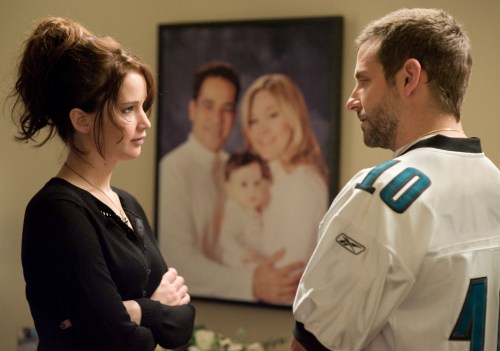
Silver Linings Playbook
Whilst in sunny Gisborne last week Seema and I got out for an evening and saw Life of Pi. Now that it has sat with me for a week I can give a more measured response to Ang Lee’s film. Whilst the book captivated me with its fantastical reveals and appropriate levels of obscurity, Ang Lee has demonstrated, perhaps intentionally, that there are some integral elements of a book that cannot be fully translated to the screen. Both mediums are obviously different and their reception is often polarised. Reception and reaction is appropriated through the various mediums of consumption. Life of Pi is a literal translation and Ang Lee’s attempt to bring Yann Martel’s Life of Pi to the big screen has brought about a visual masterpiece that so beautifully captures the sensory nature of the book … it really is stunning. However, sensory and literal does not subjectively necessitate the same experience of the book. I couldn’t help feeling that the film laid all the book’s mysteries to bear, and then proceeded to answer them too explicitly. That the process the reader goes through, trying to understand what he/she has just read, is non-existent in this film version which is just too well explained leaving the viewer with little more than an exiting visual ride. But what a ride it was. I still found this a highly entertaining and uplifting film in its own right. Book comparisons aside, I tip my hat too Lee for succeeding in all other areas. See my rating here.

As I laze in sunny Gisborne (pictured below, view from our deck, with my wonderful daughter in the foreground practicing her hula-hoop) here is an abstract from an essay I did last year on Film noir, style, themes, and existentialism. You can see it here. Ironically academic writing is a million miles away at the mo … ah the sun.

Typically I’m not one to champion watching television. Most of the junk on the box I find annoyingly addictive and such a huge investment of time that could otherwise be spent watching a film. So as of late I have eliminated nearly all television watching, and I must say that I’m really enjoying the freedom. That’s not to say there isn’t any good television out there … there are always a few notable miniseries knocking around. But again, its a real investment in time that I’m weary of. However, here’s one that I’m particular excited about. Written and directed by Jane Campion (who I think is an exceptional director), Top of the Lake is set in rural New Zealand and will star David Wenham, Mad Men’s Elizabeth Moss, and Holly Hunter. Premieres in the U.S. in March so hopefully N.Z. will have it soon after. Looks like I have my TV watching sorted for autumn already! You can read more about the mini series here.

Top of the Lake
Rian Johnson’s ambitious, yet confidently handled, sci-fi neo-noir thriller is set in a dystopian near future where mob targets are sent back in time to be “removed” by a hitman (or Looper). Time travel is always a dubious topic in cinema and is often fraught with plot holes, however, Johnson does a fine job in avoiding such pitfalls. Unfortunately in doing so he leaves us with a rather mixed bag of procedural film making laced with some fairly clever ideas. I struggled to know what to make of Looper as it pulled me in different directions. Its flawed protagonist motif ultimately did not strike a chord with me and I was left curiously dissatisfied.
See my star rating here.
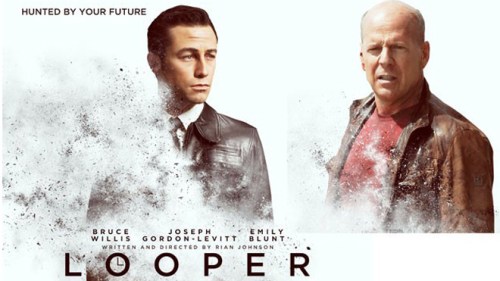
 tobywoollaston.com