
Girls of the Sun
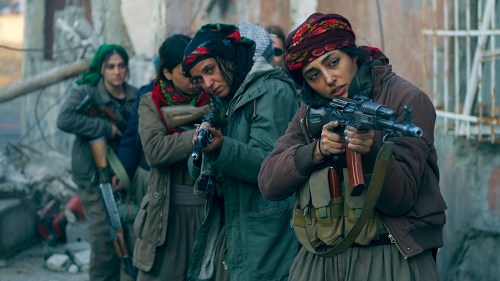 Based on true events, Girls of the Sun is set during the volatile period of Isis expansion into Kurdish territory in northern Iraq. It follows Mathilde, a French war journalist (played by Emmanuelle Bercot) as she documents a group of Kurdish women anti-Isis fighters and their struggle to reclaim their town and the children captive within. A far cry from the warmth of her role in Jarmusch’s Paterson, Golshifteh Farahani plays the battalion’s leader, Bahar, whose own horrific back-story is revealed to us through flashbacks. Her capture was just one of the many stories of women and children killed or captured and sold (along with 7000 others) as sex-slaves. They are important stories to tell for many reasons, and Girls of the Sun pays special attention to the battalion’s uncompromising female spirit in the face of a ruthless misogynistic regime.
French director Eva Husson (Bang Gang (A Modern Love Story)) handles plenty of tricky material with conviction, bringing about a movie that juggles the brutality of war with accessibility to a wider audience. In particular, Husson injects some edge-of-the-seat set pieces; a tense tunnel scene to match Sicario and a nerve-frying birthing scene reminiscent of Children of Men, are just a couple worthy of note. And while none of it is original movie-making, the sum of its parts is a bruising assault on the nerves.
Not without its faults, the film does occasionally lose focus, suffering from the (enviable) problem of having too many stories to tell; the displaced Kurdish people, the treatment of women and children, the plight of western journalists, and the personal stories of each participant all struggle for attention in a film that tries its best to narrow its scope.
As a result, Husson’s film does become a little uneven in parts—its style bouncing between a taut gritty war tale and melodrama. Nonetheless, Husson’s confident approach, if occasionally overbearing, built enough suspense and sympathy to get me swept up in the film’s cause.
See my reviews for the NZ Herald here and for Witchdoctor here.
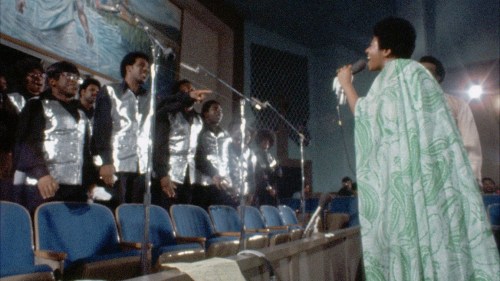 Archival footage documentaries are knocking it out of the park at the moment. And if last week’s release, the technically dazzling Apollo 11, literally took you to the moon and back, then Amazing Grace metaphorically does the same with a cinematically enthralling and spiritually charged presentation of a titanic talent.
 From the opening shot of workers ushering the gigantic Saturn V rocket into place like ants hauling a giant stick-insect, Apollo 11 broadsides you with absolute awe. First, at the enormity of man’s creation, and then at the realisation that the crystal clear images unfolding before you are half a century old.
 Breakfast Clubber, Emilio Estevez, is causing more trouble in the library, this time jumping over the counter and playing a rogue librarian rather than a rogue student.
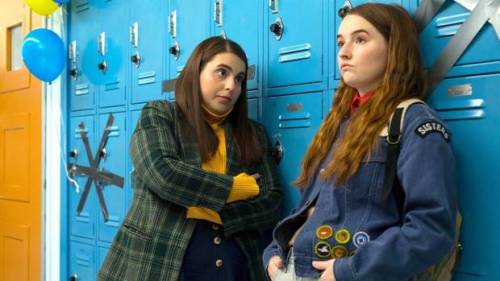 Actress and activist, Olivia Wilde, has kicked off her feature directing career with a trailblazing teen comedy that belies her inexperience as a film-maker.
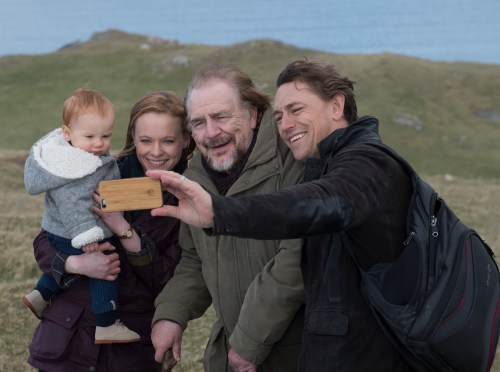 The giant acting talent of Brian Cox (Churchill) tackles the role of a cantankerous old Scotsman, Rory, who is forced from his peaty shores across the pond to seek medical treatment in San Francisco. A preference for rough-hewn edges rather than America’s modern clean lines, Rory also uses the trip to begrudgingly reconnect with his son Ian, after a fifteen-year absence. Ian is a chemist-come-chef whose Heston Blumenthal styled ultra-modern gastronomic creations wow patrons with their smokey bluster and gelatinous wonder—a far cry from Rory’s preference for black pudding and two veg. Unsurprisingly, the two don’t see eye to eye.
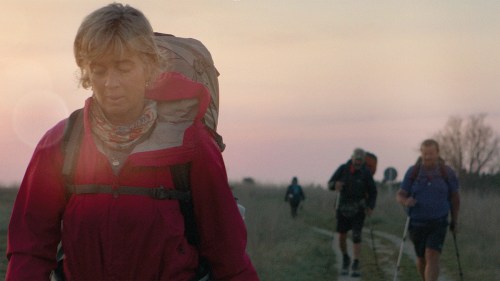 The Irish poet David Whyte once penned “abandon the shoes that had brought you here right at the water’s edge, not because you had given up but because now, you would find a different way to tread”. He was referring to the Camino de Santiago, an 800km walk that finishes at the cathedral of Santiago de Compostela in northwestern Spain. The long trek acts as a spiritual journey for hundreds of thousands of pilgrims a year, and while Whyte’s poem so eloquently expounds upon his niece’s journey through the fabled Spanish hinterland, this documentary focusses on people from our own back-yard.
 In his first feature, Belgian writer/director Lukas Dhont has tightly packed a cinematic masterpiece into a topical powder keg. It’s little wonder that a production about a transgender ballerina has courted so much controversy; the pitfalls of which were well documented by Dhont’s well-meaning, but perhaps naive blind-casting of its lead role, Lara. In the end, he settled on a cis male actor, Victor Polster, to play a teenage girl who was born a male, much to the chagrin of the trans-community who felt it more appropriate that Lara be played by a transgender actor at the very least. There are valid points on both sides of the ledger, and notwithstanding further controversies, it’s a wonder that this hot potato of a film ever got off the ground. I’m glad it did.
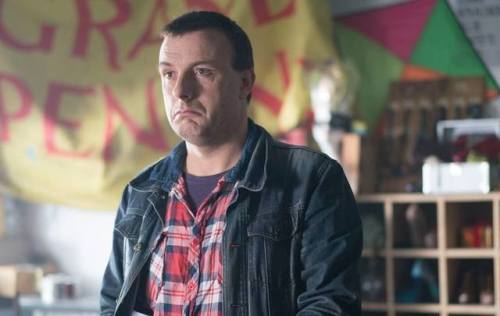 Writer, director, star and chief financier Liam O Mochain crafts a collection of sketches about life in and around an Irish train station. Although billed as a comedy, Lost & Found is very light on laughs, rather this is more an observational film that expounds on the tall-tales you’d expect to overhear at the local pub. No surprise then, that O Mochain’s anecdotal ephemera were indeed inspired by true stories; among them are wedding proposal antics, a Publican’s opening night anguish, a treasure hunting son, funeral wakes, and of course the lost property desk clerk, David (O Mochain), around whom the film loosely centres.
